

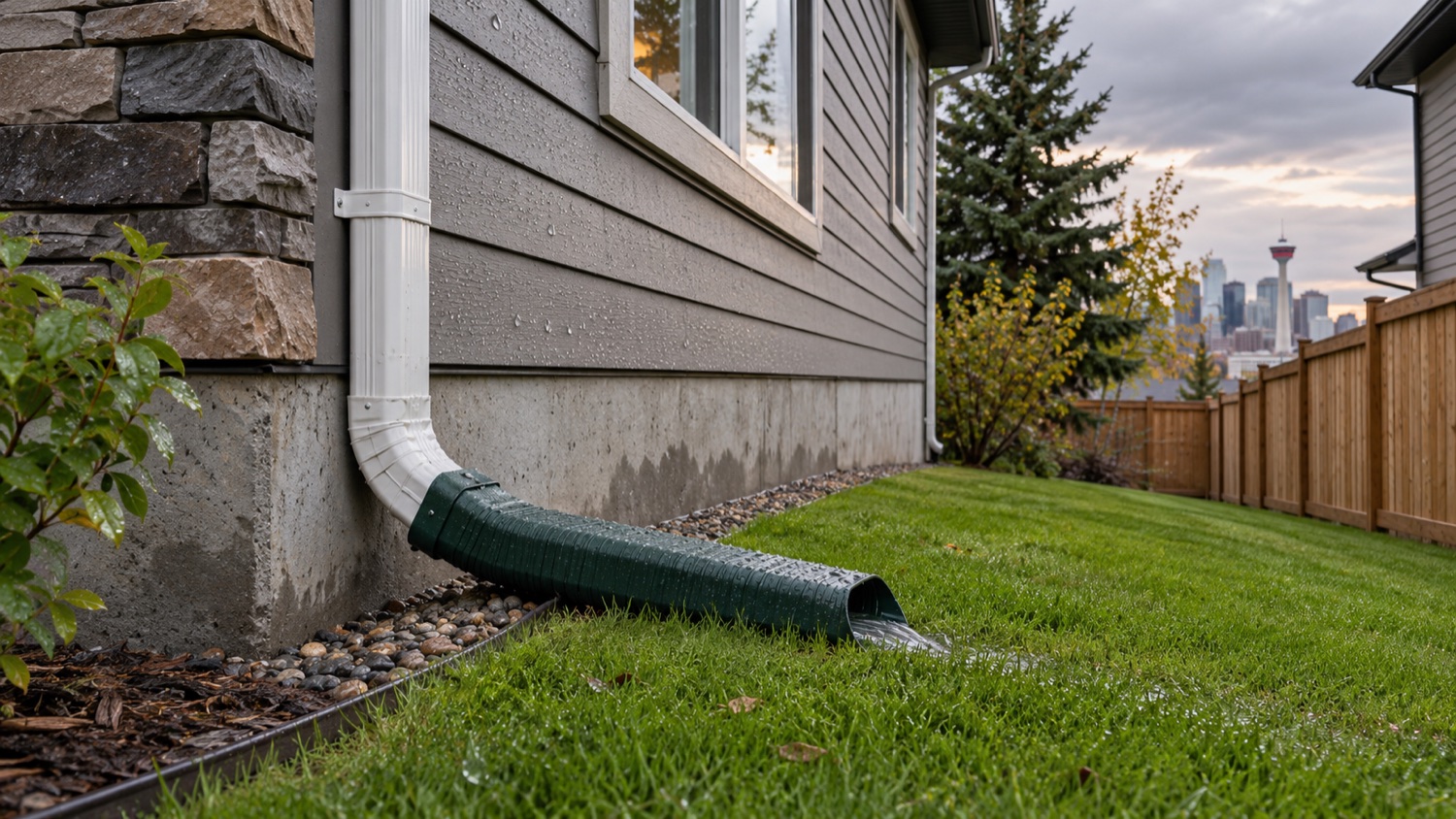
If the ground stays wet along one wall after a storm, it can be tempting to order a load of soil and build up the yard. First find out how water gets to that wall and where it can safely leave. The source could be a downspout that discharges into a shallow depression, a patio that has settled, or runoff entering from a higher section of the lot. Adding fill without following the route can send the same water to a basement window, driveway or the property next door.
A useful first walk takes you from the roof edge to the foundation and then out to the low point of the yard. Take it after the storm has passed and conditions are safe. Mark the places where water stood, how the ground slopes beside each wall and where the flow stops. If water has reached the basement, handle indoor hazards and emergency cleanup before investigating outdoors.
Start where the roof concentrates water
Each downspout drains a section of roof. In a heavy shower, the outlet can concentrate a large volume of water at one small patch of ground. Walk around the house and check how each outlet ends. A downspout may feed an extension that directs water onto grass, empty beside a patio, or connect to a buried line. Check that visible extensions are seated properly and discharge to a place where water can spread and keep moving away.
Look for sediment splashed up the wall and small channels carved into soil or mulch. Those marks tell you where concentrated flow has been reaching the ground. If an underground extension appears to back up or daylight in an unexpected spot, have it inspected before relying on it. Consider the effect of a blocked or frozen outlet in colder months. A discharge route can work in summer and collect water in a low area when snow or ice blocks the way.
Walk both sides of each hard surface
Concrete patios, walks and driveway strips can behave like shallow channels. Follow their edges and look for changes in pitch. A path may slope away from the house for most of its length but deliver water to a low landing at the side door. A sunken corner of a slab can hold water at the foundation even if the soil on either side slopes correctly.
Look a few steps beyond the visible puddle. Mark where water arrives, where it travels and where it collects. If the hard surface is driving the problem, changing the adjacent lawn alone may have little effect. A contractor can assess whether an isolated settlement, a failed joint or the larger layout of the slab determines the route. That assessment can help you decide between adjusting the landscape and correcting the concrete itself.
Look at basement windows, steps and paved thresholds
A window well or below-grade stair landing can collect water from a small area of yard that looks harmless on a dry afternoon. Examine the surrounding slope and look for a ridge or abrupt change near the opening. Leaves, silt and mulch left in a well can show where runoff has entered. If a well appears to hold water, ask about the drainage arrangement and window condition before assuming a cover will solve the issue. A cover can reduce what falls directly into a well while surface runoff can still reach its sides.
At the same time, note the space available beneath windows, siding and door thresholds. Building up the edge of a yard can reduce clearances or cover openings that should drain or remain visible. Ask anyone proposing a grade change to show how the new soil line will meet the building and how water will continue past the corner once the soil is in place.
Find the outlet before you change the slope
A gentle slope away from the foundation gives runoff a place to go for the first part of its trip. It still needs a continuous route after that. Walk the rest of the yard to find low points, existing swales, fence lines and gaps between improvements. Garden edging or a new shed pad can stop flow that used to move unobstructed along the lot. A raised bed might also divert more water into a narrow side passage.
Keep existing drainage arrangements and neighbouring properties in view. Stormwater management guidance from your municipality can explain how lot drainage and surface routes fit into a broader system. Before committing to a major grade change, have a contractor check the applicable requirements and the specific elevations on the property. Ask them to point out an outlet you can see on the plan and show which surfaces feed it. A low point with nowhere for water to drain will collect what the new slope delivers.
Compare outdoor findings with the basement pattern
Draw a simple overhead outline of the house. Put an X at each place water collected outside, and record where you first saw dampness or standing water inside. A wet lower corner beside an overflowing window well suggests an investigation that starts with the window area. Water that appears up through a drain, or beneath flooring well away from an exterior wall, may require a plumber or other specialist to investigate a different route. More than one source can be involved in one event.
Take a few photographs before the yard dries, if you can do so safely. A picture of flow curling around a patio edge tells a contractor more than a picture of the dry corner the following week. Also note the recent weather, where the downspouts were pointed and whether water appeared on the surface or simply remained in saturated soil. Keep photographs taken after repeated storms in the same folder so a contractor can tell which patterns recur.
Handle indoor damage while the drainage problem is investigated
If water has entered the basement, keep people away where electrical equipment may be affected, where access is unsafe or where water could be contaminated. Follow local guidance for re-entry and contact a qualified professional to assess affected areas. Exterior grading changes address a possible route for future water. Separate work may be needed to assess wet wall cavities, remove contaminated materials or dry portions of the floor assembly after the current event.
A flood restoration company can explain how indoor damage is assessed and what to expect during cleanup. Share your photos and timing with the team that takes on your restoration and with any contractor looking at the grades. It helps if both teams know which areas were wet and which source repairs are planned. Ask what needs to be confirmed before interior finishes are closed and rebuilt.
Review the work after the next rain
When you receive a proposal, ask which heights will change, what the contractor expects water to do and what you should be able to observe after the work. Ask how the grade will meet existing steps, fences, slabs and siding. If the work relies on a swale or extension, check which part of it needs routine maintenance. Projects that look similar on paper can perform differently where a downspout concentrates flow or a path crosses the proposed drainage route.
After a safe opportunity to check in wet weather, revisit the old low spots. Does water still pause at the patio corner? Has the surface route shifted into a window well? Is the discharge still clear at the end of the extension? Compare a few photographs from the original walk with the new conditions. A successful correction gives water a continuous path away from the structure and leaves you with features whose purpose you can see and maintain.
Easy steps to create a color palette
Lorem ipsum dolor sit amet, consectetur adipiscing elit lobortis arcu enim urna adipiscing praesent velit viverra sit semper lorem eu cursus vel hendrerit elementum morbi curabitur etiam nibh justo, lorem aliquet donec sed sit mi dignissim at ante massa mattis.
- Neque sodales ut etiam sit amet nisl purus non tellus orci ac auctor
- Adipiscing elit ut aliquam purus sit amet viverra suspendisse potent
- Mauris commodo quis imperdiet massa tincidunt nunc pulvinar
- Excepteur sint occaecat cupidatat non proident sunt in culpa qui officia
What is a color palette?
Vitae congue eu consequat ac felis placerat vestibulum lectus mauris ultrices cursus sit amet dictum sit amet justo donec enim diam porttitor lacus luctus accumsan tortor posuere praesent tristique magna sit amet purus gravida quis blandit turpis.

Don’t overspend on growth marketing without good retention rates
At risus viverra adipiscing at in tellus integer feugiat nisl pretium fusce id velit ut tortor sagittis orci a scelerisque purus semper eget at lectus urna duis convallis porta nibh venenatis cras sed felis eget neque laoreet suspendisse interdum consectetur libero id faucibus nisl donec pretium vulputate sapien nec sagittis aliquam nunc lobortis mattis aliquam faucibus purus in.
- Neque sodales ut etiam sit amet nisl purus non tellus orci ac auctor
- Adipiscing elit ut aliquam purus sit amet viverra suspendisse potenti
- Mauris commodo quis imperdiet massa tincidunt nunc pulvinar
- Adipiscing elit ut aliquam purus sit amet viverra suspendisse potenti
What’s the ideal customer retention rate?
Nisi quis eleifend quam adipiscing vitae aliquet bibendum enim facilisis gravida neque euismod in pellentesque massa placerat volutpat lacus laoreet non curabitur gravida odio aenean sed adipiscing diam donec adipiscing tristique risus amet est placerat in egestas erat.
“Lorem ipsum dolor sit amet consectetur adipiscing elit, sed do eiusmod tempor incididunt ut labore et dolore magna aliqua enim ad minim veniam.”
Next steps to increase your customer retention
Eget lorem dolor sed viverra ipsum nunc aliquet bibendum felis donec et odio pellentesque diam volutpat commodo sed egestas aliquam sem fringilla ut morbi tincidunt augue interdum velit euismod eu tincidunt tortor aliquam nulla facilisi aenean sed adipiscing diam donec adipiscing ut lectus arcu bibendum at varius vel pharetra nibh venenatis cras sed felis eget.